Industrial vs Artisanal Tequila: The Difference That Defines the Experience
Talking about tequila means talking about Mexican identity, the agave landscape, and a tradition that has evolved over centuries. Yet behind the same denomination of origin, two very different worlds coexist—worlds that are rarely explained clearly to the consumer: industrial tequila and artisanal tequila. Both are legitimate, both can meet regulatory standards, but they are not equivalent in terms of sensory experience, production philosophy, or cultural value.
Understanding these differences does more than elevate appreciation—it fundamentally changes how tequila is consumed, purchased, and experienced.
A Shared Origin: Agave as the Foundation
Both industrial and artisanal tequila begin with the same essential ingredient: blue agave (Agave tequilana Weber, blue variety). This plant, native to Jalisco and a few authorized regions, is the heart of the spirit.
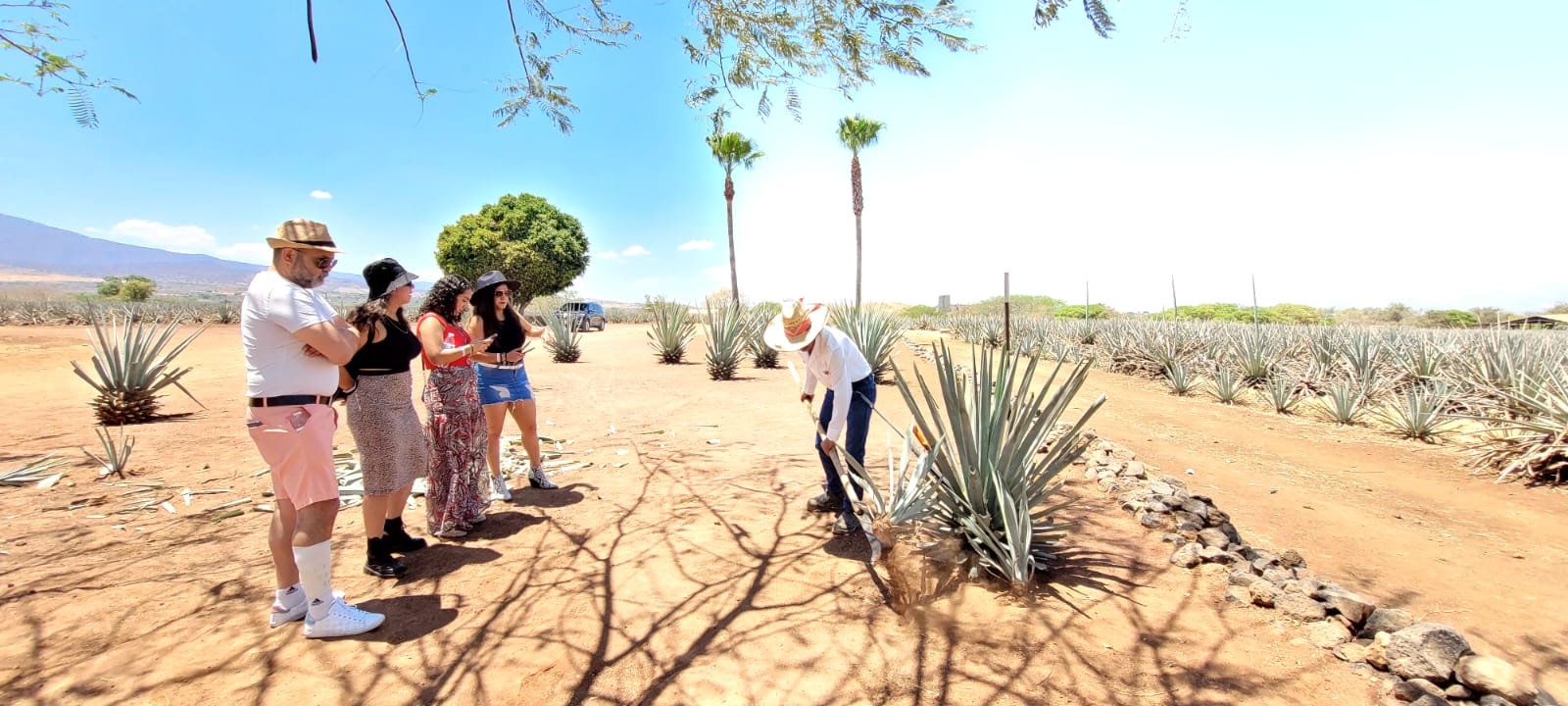
The difference lies not in the raw material, but in how it is treated throughout the production process. That is where efficiency and expression begin to diverge.
Production Philosophy: Volume vs Identity
Industrial tequila operates under a global market logic. Its goal is to produce large volumes efficiently, consistently, and profitably. This requires accelerated, controlled, and standardized processes to ensure that every bottle tastes nearly identical, regardless of the batch.
Artisanal tequila follows a completely different philosophy. It aims to preserve traditional methods, respect the natural timing of the agave, and express unique characteristics of the terroir, the process, and the producer. Here, uniformity is not the goal—personality is.
In simple terms, industrial tequila seeks replicability; artisanal tequila seeks authenticity.
Cooking the Agave: Speed vs Slow Transformation
One of the most critical stages in tequila production is cooking the agave, where starches are converted into fermentable sugars.
In industrial production, this is typically done in autoclaves—large stainless-steel ovens that use high-pressure steam. This method can complete the process in a matter of hours, enabling rapid production at scale.
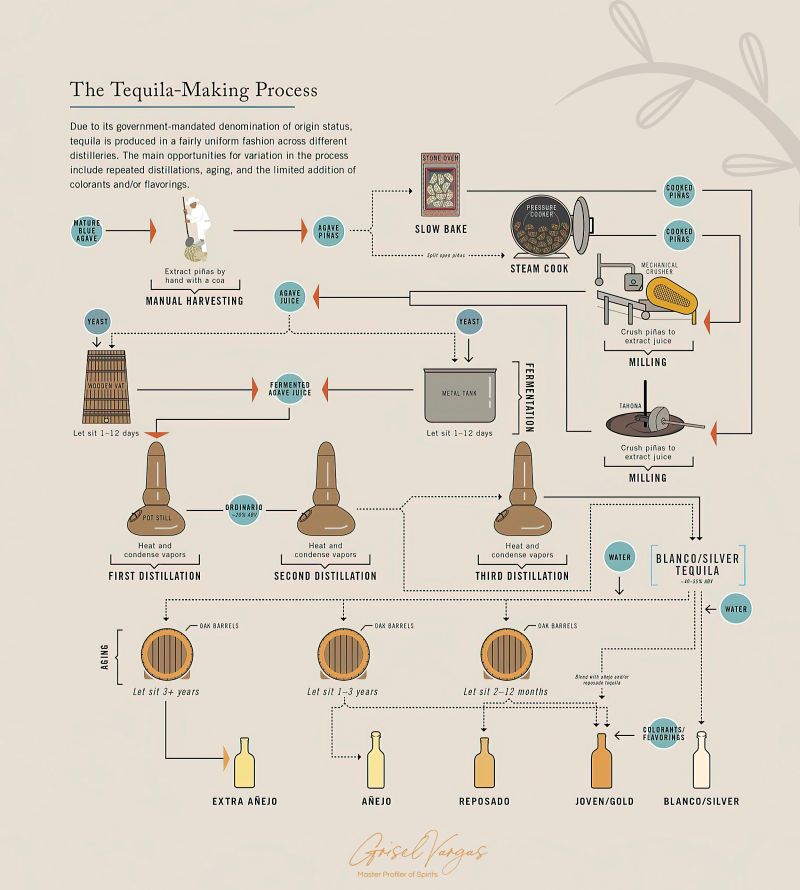
In artisanal production, agave is cooked in traditional masonry ovens. These ovens operate slowly, often over 48 hours or more. This extended cooking time allows for a more even transformation and the development of deeper aromatic compounds, including rich caramelized and honeyed notes.
The result is a clear difference in the sensory profile. Industrial tequila tends to be more direct and linear, while artisanal tequila offers layered complexity that evolves on the palate.
Extraction: Maximum Efficiency vs Respect for the Fiber
After cooking, the agave must be crushed to extract its juices.
Industrial producers often use diffusers, a highly efficient technology that can extract sugars even from undercooked or immature agave. While this maximizes yield, it can also introduce less desirable compounds.
Artisanal producers rely on methods such as the tahona—a large volcanic stone wheel—or more traditional milling techniques. These methods are slower and less efficient in terms of volume, but they preserve the integrity of the agave and produce more balanced musts.
The distinction is fundamental: the diffuser extracts everything possible; the tahona extracts what matters most.
Fermentation: Absolute Control vs Natural Interaction
Fermentation is where sugars are converted into alcohol. In industrial settings, this process takes place in stainless-steel tanks using selected yeast strains under tightly controlled conditions. The goal is consistency and speed.
In artisanal tequila, fermentation may occur in wooden vats or even open-air containers, allowing interaction with wild yeasts present in the environment. This introduces variability, but also complexity.
At this stage, tequila begins to develop its character. Yeast, climate, and environment all influence the final aroma and flavor profile.
Distillation: Technical Precision vs Character Expression
Both industrial and artisanal tequilas typically undergo double distillation, but the equipment and approach can differ.
Large industrial distilleries use modern stills designed for efficiency and uniformity. Artisanal producers often use smaller copper stills, which allow for more hands-on control and subtle variations in the distillate.
The difference is not about technical capability, but about intent. Industrial production minimizes variation; artisanal production embraces it.
Additives: Standardization vs Purity
One of the least discussed but most important distinctions involves additives.
Regulations allow certain tequilas—especially aged expressions—to contain small amounts of additives such as caramel coloring, glycerin, or oak extract to adjust color, texture, and flavor. Industrial producers frequently use these tools to maintain a consistent profile.
Artisanal tequila generally avoids additives or uses them minimally. The goal is to let the flavor come entirely from the agave, fermentation, and maturation process.
This has a direct impact on the consumer experience. A tequila with additives may feel smoother or sweeter, but it may also lack authenticity.
Sensory Profile: Predictable vs Complex
Ultimately, everything translates into what is experienced in the glass.
Industrial tequila is typically clean, approachable, and predictable. It works well in cocktails and is easy to drink, but it rarely surprises.
Artisanal tequila can offer a much broader spectrum of aromas and flavors: herbal, mineral, floral, spicy, or earthy notes that reflect the agave and the environment. Each batch can tell a slightly different story.
This complexity is one of the reasons artisanal tequila has gained strong traction in the premium and luxury segments.
Representative Examples
To better understand these differences, it helps to look at specific producers.
Among large-scale industrial producers are brands like Jose Cuervo and Sauza, which have built global empires based on volume, consistency, and wide distribution. These companies rely on modern technologies to supply international markets efficiently.
On the artisanal side, producers such as Tequila Fortaleza and Siete Leguas have maintained traditional processes and a deep connection to tequila’s heritage. Their production is typically smaller, with a focus on quality over quantity.
It is important to note that this is not about labeling one as good and the other as bad. Each serves a purpose in the market. The issue arises when consumers lack the information needed to distinguish between them.
Cultural and Economic Impact
Industrial tequila has played a crucial role in positioning tequila as a global spirit. Without large-scale production, tequila would not have achieved its current international presence.
At the same time, artisanal tequila plays an equally important role in preserving traditional knowledge, craftsmanship, and cultural heritage.
From an economic perspective, the growth of artisanal tequila has created new opportunities for small producers, rural communities, and more specialized tourism experiences.
The Visitor Experience
For those visiting the tequila region, understanding these differences transforms the journey.
A visit to an industrial distillery can be impressive in scale and efficiency, showcasing the modern side of the industry. In contrast, a visit to an artisanal distillery is often more intimate, educational, and immersive.
Visitors do not just observe the process—they engage with it, understand it, and experience it firsthand. This distinction is crucial in today’s tourism landscape, where authenticity is increasingly valued over passive observation.
Conclusion: Two Paths, One Choice
Industrial and artisanal tequila are not adversaries, but they represent two distinct philosophies. One prioritizes efficiency and consistency; the other prioritizes identity and expression.
For the informed consumer, the choice goes beyond price or availability. It becomes a question of what kind of experience one wants to have. There are moments for accessible, functional tequila, and there are moments for tequila that invites reflection, exploration, and connection.
In the end, understanding these differences does more than refine taste—it connects the drinker to the land, the people, and the traditions that make tequila one of the most iconic spirits in the world.